
Places
YodfatAlternative names: Iotapata, Yodefat, JotapataPlace descriptionThe town was located on an isolated spoon-shaped hill surrounded by steep dry riverbeds and accessible only from the north. The size of the site is about 50 dunams (5 hectares; 13 acres), which could contain about 1500-2000 people. The town was first built in the Hellenistic period mainly on the upper level of the hill. Under the Hasmonean dynasty the hilltop was surrounded with thick walls and towers. Before the Revolt broke out in the Galilee, the rest of the spoon-shaped town was surrounded with wall and towers. After its destruction the original site was never built over, though a small Byzantine village was later built (in part using materials from the original town) to the north on the nearby hillside.<br>Excavations took place at Yodefat from 1992 to 1999 and uncovered the remains of the town wall, residential areas including a large mansion with fresco walls in the Second Pompeian style. Clear evidence of a heavy battle as described by Josephus was found all over the site: some nails from the Roman army sandals (caliga), more than a hundred arrowheads and catapult bolts, and many ballista stones. On the northern slope of the hill, a deep layer of soil and stones, mixed with pottery dated not later than first century CE and covered by a layer of white mortar mixed with crushed pottery, was uncovered. Inside and under this layer of mortar, some arrowheads were found, suggesting that these layers of soil, stones and mortar were built during a heavy battle. These layers were identified as the remains of the Roman army assault ramp. The town was found destroyed with patches of ashes in some houses. On the houses’ floors, arrowheads and ballista stones were found. In the “fresco house” human bones and arrowheads were found on the painted plastered floor, covered with heavy debris of the house. In some of the cisterns, collected human bones and skulls were found, sometimes enclosed with stones or simple walls. No remains of later periods were identified in the houses or the cisterns, and the latest coin found on the floors is from the time of Emperor Nero (Adan-Bayewitz and Aviam 1997).<br>Though the evidence on the original hilltop has been largely obscured by later erosion, the evidence of residential neighborhoods in other parts of the hilltop, the side hills, and the lower plateau has given a clear sense of Yodefat as a small, largely residential, Galilean town. Houses were of rough masonry, probably mud-plastered, with roofs of small wooden beams and branches, covered with repeated layers of mud. On the steeper eastern slopes, the houses were terraced, with party walls supporting floors and roofs at various levels. Houses had individual cisterns, in one case with intact collecting basin and channels to the cistern and to the adjacent street (for overflow). Two houses side by side on the southern plateau each had mikvaoth, one an installation in the floor, the other a rock-cut cave type mikveh. The walls of the southern portion of the town showed clear evidence of being built hurriedly in the early stages of the Revolt, though the southeastern wall had several towers. Just below the wall on the western side of the lower plateau was a complex and very carefully contrived tunnel, with gabled roof made of large ashlars, leading to underground chambers, probably used as shelters during the War. Just outside the eastern wall, near the houses with the mikvaoth, were two large adjoining natural caves, the southern one of which had an almost completely intact large oil press with crushing pit, and two pressing installations. <br> Small finds. Several column drums were found, both on the southern plateau and in the later Byzantine village, where a couple of capitals were also in secondary usage. One piece of architrave with simple moldings was found on the surface on the northwest, and a large piece of doorjamb (over 2 m. High) was found in secondary usage to frame the corner of a house in the southeast. These finds are all suggestive of monumental building, of which no in situ evidence has been found. Numerous loom weights and spindle wheels suggest that one of the town’s main occupations, in addition of olive oil, was wool production. Pieces from various sizes and shapes of stoneware vessels were founds in all areas of the excavation, suggesting, along with the mikvaoth, at a ritually observant population. Images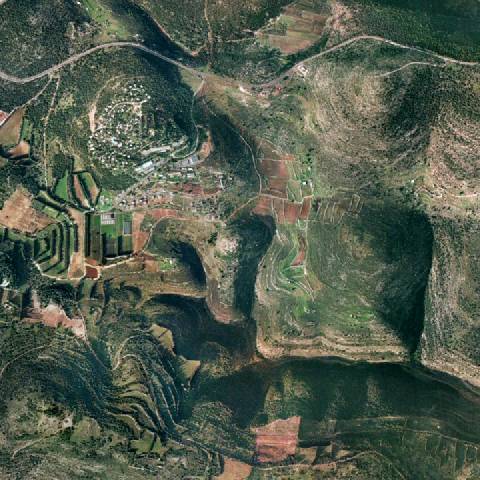 Jotbah_Jotapata_Yode 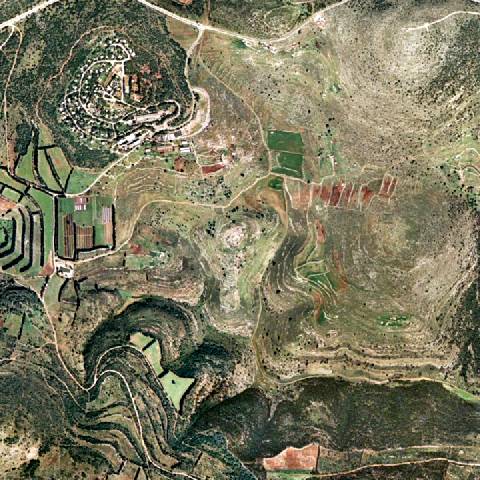 Jotapata 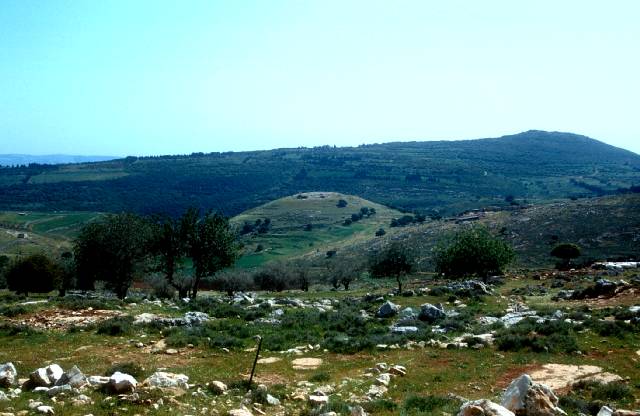 Yodefat, tb 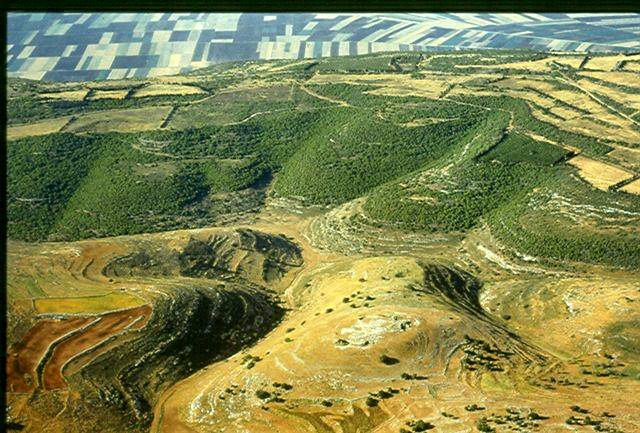 Yodefat and Lower Galilee to S |