
Places
Tell AshqelonAlternative names: Ashkelon, AscalonPlace descriptionAshkelon lies on the southern coast between Ashdod and Gaza; V. Guérin, G. H. Güthe,
C. Schick, and the Survey of Western Palestine, among others, surveyed it in the
nineteenth century BCE. J. Garstang and W. J. Phythian-Adams carried out the first
archaeological excavations in the 1920s (Garstang 1924). Thereafter, minor salvage
excavations were carried out in the vicinity of the tell. Remains of the Roman and
Byzantine periods were uncovered in the present day neighborhood of Afridar, 2 km north
of the tell. In the neighborhood of Barnea’ (4.5 km north of the tell), about 300 meters
inland, Roman period tombs, decorated sarcophagi, and two Byzantine period churches, as
well as a large concentration of other Byzantine remains were uncovered (Israel 1995;
history of research in Stager 1993). From 1985 onward, L. E. Stager has carried out
excavations on Tell Ashkelon for the Harvard Semitic Museum (Stager 1991, 1993). An
extensive survey south and east of Tell Ashkelon was connected with the project (Allen
2001). Additional excavations have been carried out north of the tell recently,
including a Byzantine burial site and agricultural installations, testifying to the
city’s extensive economic development. The following description includes Persian,
Hellenistic and Roman period remains; extensive Hellenistic finds have been reported but
are not yet fully published. After Ashkelon was destroyed at the end of the seventh
century BCE, settlement was renewed in the Persian period. Herodotus mentions Ashkelon,
particularly the temple of Aphrodite built by Phoenician residents of the city, which
was destroyed by the Scythians (Hist. 1.105). In Pseudo-Scylax 104 (mid-fourth century
BCE), Ashkelon is mentioned as the southern-most city of Coele-Syria, inhabited by
Sidonians, with a royal palace. Coins with the letters “a” (), aleph) and “n” (n, nun)
in Phoenician script were minted in Ashkelon in the Persian period, most likely as an
abbreviation of the city’s name. They show Phoenician influence in the city; the
dolphins that decorate them were a well-known symbol of Sidonian coins from the fourth
century BCE (Meshorer 1989; contra Rappaport 1970). R. Gitler published a coin hoard
from the fourth century BCE found on Tell Ashkelon, probably minted in Ashkelon itself
(Gitler 1996). Stager identifies four Persian period strata at the southern end of the
tell, including a cemetery with over 800 dog burials—the largest dog cemetery known from
antiquity—all apparently hunting dogs. It was first established in the early fifth
century and used until the late fourth century BCE. The dogs, buried in shallow graves,
all had died a natural death; they were not put to death. While full understanding of
these burials has not yet been reached, they seem to have been connected with Phoenician
cultic practice (Stager 1991a; Heltzer 1998). Imported Persian period finds from eastern
Greece and Attica show the strong Greek influence on the city beginning in the fifth
century BCE. Egyptian imports were also found: scarabs, beads, bronze amulets, and
statuettes of Osiris and other Egyptian gods. The excavations uncovered portions of a
large building, tentatively identified as the palace mentioned in Pseudo-Scylax. In two
other late-Persian buildings (fourth century BCE) more evidence of Phoenician cultic
practice was brought to light: terracotta scarabs, statuettes, and pendants related to
the worship of the Phoenician goddess Tanit. Persian period Phoenician ostraca were
found, as well as a cup from “eastern Greece” with the word “ugam” (“cakes”) in
Phoenician script. More evidence of Phoenician presence comes from the tomb of an
Ashkelon resident discovered near Athens, with a bilingual Greek and Phoenician
inscription dated from the early fourth century BCE. Contrary to previous opinions that
Ashkelon was subordinate to Ashdod in the Persian period, the archaeological,
historical, and numismatic evidence shows that Ashkelon was an independent city (Lemaire
1994). Unlike Ashdod, however, Ashkelon is never mentioned as an independent district in
Ezra and Nehemiah; this need not exclude the possibility that Ashkelon became
increasingly important through the fifth and fourth centuries BCE, until it eventually
surpassed Ashdod in importance. Since there is no evidence of a Macedonian conquest of
Ashkelon, the city probably submitted to Alexander the Great without resistance, in
contrast to Sidon and Gaza. When Ptolemy I Soter retreated from the land of Israel in
301 BCE, he ordered the destruction of four of its important cities, including Gaza and
Jaffa but not Ashkelon. Still, a destruction layer covers the entire tell, dated about
300 BCE (Stager 1993). Ashkelon must have been caught in one of the many confrontations
that took place in the land of Israel during that time. Though Gaza is mentioned
numerous times in the Zenon papyri, Ashkelon is mentioned only once, suggesting that
Gaza was the most important city and port in the area during the Ptolemaic period.
Ashkelon may have taken a long time to recuperate from its destruction around the year
300 BCE. It is also mentioned in connection with the acts of Joseph son of Tobias, the
deputy responsible for collecting taxes from Syria and Phoenicia during the Ptolemaic
period. According to the account, citizens refused to pay their taxes and insulted him
as well. In retaliation, Joseph captured and killed twenty of the city’s elite and used
their confiscated property to pay the amount due, thereby earning the fear of the other
cities and the respect of the Ptolemaic court (Ant. 12.181-82). Although Ashkelon is
mentioned in the Letter of Aristeas (115), its port is not, possibly because it was not
as important as those of Jaffa, Akko and Gaza (Rappaport 1981). For many years scholars
have attempted in vain to locate Ashkelon’s ancient port. Given that the sources rarely
mention a port at Ashkelon and that the sandy shoreline lacks even the slightest natural
bay, no harbor was ever built in antiquity. Research in the last few years has focused
on the incessant erosion of the shoreline: a collection of anchors, sunken vessels,
concentrations of marble and granite columns, various fishing implements, as well as
pottery gathered in the depths of the sea. Apparently ships made use of underwater
kurkar ridges and other rocky banks to assist with anchorages, unloading their
commercial cargo with the help of smaller boats (Galili, Sharvit and Dahari 2001). Above
the destruction layer from about 300 BCE, three insulae were discovered with elaborate
buildings, used almost without interruption until the fourth century CE, when a
bathhouse was built over them. Elaborate third-century BCE remains have been discovered
north of the tell in the modern neighborhood of Barnea’ (well outside the fortified
city), with dwellings, streets, walls, and cooking implements in a rare state of
preservation; apart from the initial media reports, these findings have not yet been
scientifically published. Ashkelon must have simply passed to the Seleucids without
resistance, judging from the texts’ silence. During Seleucid rule Gaza’s domination
began to falter, and Ashkelon gradually developed into the most important city along the
southern coast. The best evidence is numismatic: Gaza minted many coin types during the
Ptolemaic period, while few were minted in Ashkelon (Ptolemy IV Philopator minted silver
coins at Ashkelon during the third and fourth years of his reign, 220-218 BCE); in the
Seleucid period, however, the situation was reversed (Rappaport 1970). The reason was
that Gaza opposed Seleucid rule while Ashkelon supported it. Contrary to earlier views,
Ashkelon began minting coins in 169/168 BCE under Antiochus IV Epiphanes, one of only
two mints in the land of Israel, alongside Ptolemais. Even more important, Ashkelon
independently minted bronze coins dated to years 144 and 145 of the Seleucid reckoning,
(169-167 BCE). They showed on one side the head of Tyche, the city’s goddess, and on the
other a war ship surrounded by an inscription: “the dêmos (people) of Ashkelon,”
implying the partial independence of the city, unique in the Seleucid kingdom during
this period except for Arados in northern Phoenicia (Spaer 1984; Barag 2002). Ashkelon’s
preferential treatment may only have lasted those two years: in 166/5 BCE, while the
minting of coins continued, they no longer included the “independent” bronze coins
(Barag 2002). Ashkelon is not mentioned as one of the cities that fought against Judah
Maccabee in the initial stages of the Hasmonean revolt. In 147 BCE, the citizens
welcomed Jonathan and his army, who had been fighting near Ashdod against Apollonius,
Demetrius II’s representative (1 Macc 10:86). It seems their complicity was political,
both being supporters of Alexander Balas; several years later, when the conflict with
Demetrius II was renewed, Ashkelon again received Jonathan warmly (1 Macc 11:60; Ant.
13:149). In 143 BCE Simon son of Mattathias led a campaign in the area and built several
fortresses and strongholds (1 Macc 12:33; Ant. 13:180). The good relations between Judea
and Ashkelon meant that the city retained its independence, and in the late 140s BCE,
during Trypho’s rule, coins were even minted in Ashkelon (Rappport 1981). Seleucid
control waned in the 120s BCE, yet between 123 and103 BCE Ashkelon continued to mint
coins unabated. The numismatic evidence demonstrates the changes in leadership along the
entire southern coast, and specifically in Ashkelon, during those two decades (Spaer
1984; Barkay 1993). Of particular note are the coins dated to year 201 in the Seleucid
reckoning (112/111 BCE): “[Ascalon] holy, city of asylum,” titles that imply the rights
of the city and its citizens, religiously, legally, and economically, the latter shown
by exemption from taxes. A series of coins minted in 106/105 BCE included a longer
inscription, “Of the people of Ascalon, holy, city of asylum,” but no longer had the
year according to the Seleucid calendar. The city enjoyed increasing independence, most
likely because Seleucid government was crumbling. By 104 or 103 BCE, the city began
using its own independent calendar (Schürer-Vermes 2.106 n. 102). Alexander Janneus did
not conquer Ashkelon; it is not in the list of Janneus’ conquests (Ant. 13.395) or in
the list of cities liberated by Pompey. The dates on its coins still used the
independent calendar begun in 104/103 BCE, not Pompey’s standard. Ashkelon was an
independent city until the Roman conquest. Several intellectuals originated in Ashkelon
from the Hellenistic period onward, according to the lexicon of Stephanus Byzantius,
which was based on older documents. The first-century BCE stoic philosophers Sosus and
Antiochus of Ascalon, though living in other Mediterranean cities such as Athens,
probably began their education in Ashkelon. Several Hellenistic educational
institutions, such as the Gymnasium, operated in the city (Geiger 1991). Other evidence
of Ashkelon’s Hellenistic expansion, especially from the second century BCE onward,
comes from numerous epigraphs recording the presence of Ashkelonites in various cities
throughout the Mediterranean world—Athens, Demetrias, Delos, and Rhodes—bearing witness
to Ashkelon’s thriving commerce that grew tremendously in the Hellenistic period (Fuks
2001: 94-96). Ashkelon’s pantheon illustrates the city’s growth. Herodotus tells of the
establishment of Aphrodite’s cult, probably a Hellenized version of the cult to Astarte,
which is confirmed numismatically. Seleucid coins bore Astarte’s image as goddess of the
city, but in the second century BCE, they showed the dove, the holy bird of the
Aphrodite cult. Diodorus Siculus (first century CE) records ancient traditions of
Ashkelon, with a large, deep lake full of fish, on whose shores stood a temple to a
goddess whose head was a woman and whose body was a fish. The goddess Derketo was a
local variant on Atargatis, the goddess of water and fertility. Although the lake beside
Ashkelon was only legend, the cult was depicted on late-Roman coins, though no remains
of a temple have been found. Hercules’ was worshipped in the city in the Roman period,
possibly continuing Phoenician worship of Melqart. Phoenician religious influence may
lie behind Phanabalos—a hellenized version of the Phoenician expression “Pan and
Baal”—who appears on Ashkelon’s coins from the first century CE, although the cult’s
relationship to Ashkelon and the circumstances of its appearance are unclear (Fuks 2000a
and literature listed there). Ashkelon continued to be influenced in the Hellenistic
period by ancient Syrian-Phoenician cultic practices, as well as by Greek Olympian cults
and Egyptian practices (Friedheim 2001), parallel to the process of hellenization in
other eastern Mediterranean cities (Millard 1983). Although Janneus did not conquer
Ashkelon, rabbinic literature tells of Simon son of Shatah, who murdered 80 sorcerers in
the city (m. Sanh. 5.3; y. Hag. 2.2; 77.4 – 78.1) which seems to imply a measure of
Jewish control. Simon lived during the days of Janneus and Salome, and was considered an
authority in pharisaic circles during the days of Salome. It is difficult to reconcile
this event with the city’s almost total independence during Hasmonean rule (Efron 1987:
143-218). The account could be an echo of an incident when women suspected of sorcery
took refuge in Ashkelon, hoping they would not be handed over to the Hasmoneans. The
city, however, collaborated with the Hasmoneans and handed the women over (Ilan 2001).
Possibly the well-documented influx of Jews in first century CE Ashkelon had already
begun during the days of Janneus or Salome, though it may not have started until the
days of Herod the Great (Fuks 2000). Ashkelon is mentioned twice in connection with
events in the 40s BCE. When Aristobulus II sent his wife and two daughters to Ashkelon
for protection, Ptolemy, governor of the Itureans, had his son take them to Chalcis (War
1.185-86; Ant. 14.126). When Julius Caesar was still consolidating his position, shortly
after the murder of Pompey (48-47 BCE), troops were dispatched to Alexandria to rescue
Caesar who was held up there in a siege. They gathered at Ashkelon, where Antipater, the
father of Herod the Great, assisted them under the patronage of Hyrcanus II (Ant.
14.139; 19.198-99; Richardson 1996: 103-8). It may be that Ashkelon was given for a
brief period to Cleopatra in the 30s BCE, along with the rest of the coast, except for
Tyre and Sidon (Ant. 15:95); if so, this was a very short episode in Ashkelon’s history,
as the coins continue to testify to its independence even after the Roman conquest. The
relationship between Ashkelon and Herod the Great has been controversial (Kokkinos
1998). Josephus makes it clear that Ashkelon was not ceded to Herod the Great in 30 BCE
(War 1.396; Ant. 15.217), yet Herod built monumental buildings there: bath houses,
elaborate fountains, large colonnades. It was one of the cities outside his kingdom that
he built up (Richardson 1996: 174-76). That Herod had a palace within the city is
evident from his will, which ceded the palace to Salome, his sister (War 2.98; Ant.
17.321; Richardson 1996: chap. 2). The palace’s existence is a central argument in the
claim that Herod enjoyed a good relationship with the city. Julius Africanus, a
Christian, is quoted by Eusebius on Herod’s relationship with Ashkelon (Hist. Eccl.
1.6.2-3; 7.11). According to him (and Justin Martyr in the second century CE), Herod and
his father Antipater worshiped in Apollo’s temple in Ashkelon. Edomite brigands are
supposed to have captured Antipater, but because his father could not pay the ransom
they kept him prisoner in Edom, where eventually his son Herod was born. Most scholars
doubt this version of Herod’s origins because it contradicts Josephus’ claim that Herod
descended from a noble Idumean family (War 1.123); the tradition was meant to blacken
Herod’s ancestry, and likely had its origins in Jewish anti-Herodian circles (Shalit
1962; Fuks 2000). Kokkinos, however, suggests that the tradition is based on reliable
historical elements: Herod’s family origins were in Ashkelon, but, contrary to the
accounts, the family would have come from the upper aristocratic levels of Hellenistic
Phoenician society. Josephus, following his source Nicolas of Damascus, suppressed
Herod’s Ashkelon origins for various reasons (Kokkinos 1998: 100-12). Kokkinos seeks
other hints that Ashkelon was the ancestral city of the Herodian family from coins
minted by the family (1998: 112-39). The thesis is difficult to uphold, if for no other
reasons than that Ashkelon was never given to Herod as a royal estate and that his
construction projects in the city were similar to those in other cities outside his
kingdom (Richardson 1999; Fuks 2000; Kasher 2002). Most of the Roman-period remains at
Ashkelon are from the second and third centuries CE, and so beyond the scope of this
appendix. Josephus mentions peristyle halls, and J. Garstang’s excavations in the 1920s
uncovered a basilica comprising an apse with rooms on the sides and a corridor
twenty-four columns long by six across (110 by 35 m). Inside the building were marble
statues: the goddess Nike standing on a globe carried on Atlas’ shoulders, the Egyptian
goddess Isis with her son Horus, and several others, all dated to the third century CE
stylistically. Garstang suggested, however, on the basis of two inscriptions, which
mentioned the boulê (“council”) and the dêmos (“people”) of the city, that the building
was erected during the Herodian period, consistent with the coins mentioned above. He
further suggested the building combined a bouleutêrion and a colonnaded hall. Stager
doubts Garstang’s dating and, based on small finds as well as architectural style,
claims the building was no earlier than the Severi (Stager 1991b). M. Fisher has
restudied the entire building and proposes four stages: Hellenistic, Herodian, the main
Severan stage, and Byzantine (Fischer 1995). Near it another public building was visible
in the nineteenth century, but its remains are no longer identifiable. There is still
insufficient proof that the basilica had a Herodian phase; it seems that a Severan
basilica was built on an earlier Hellenistic building (Fuks 2001: 56-61). No elaborate
Herodian-period bathhouse has been discovered, although there is one from the Byzantine
period. Kokkinos has suggested that Herod’s palace was built on remains of the Persian
period palace mentioned in the historical sources, though there is no evidence for this.
In summary, late Roman remains have yet to be properly documented and studies are
predominantly dependent on the map of the late Roman and Byzantine period remains
(Stager 1991b). There are few finds from the early Roman period (Roller 1998: 216-18).
The extensive late-Roman construction projects might have concealed early Roman
buildings, but only study focused on this particular issue will reveal the features of
these earlier periods. Historical data about Ashkelon during the first century CE deal
primarily with relations between local residents and Jewish settlers who sought refuge
during the first revolt. Prior to the revolt (and contrary to other cities) there are no
indications of tension between the non-Jewish and Jewish elements of the city; sources
reflect a decent relationship between the two groups. It seems probable that Jewish
settlement in the city did not start prior to the Herodian period. Philo first records a
change in relations in On the Embassy to Gaius. The conflict that prompted Caligula to
erect a statue of himself in the temple in Jerusalem began at Yavneh; Apelles, one of
Caesar’s advisors, who had encouraged Caligula to erect the statue, was an actor in a
famous tragedy that had come out of Ashkelon. Philo adds that Apelles did so because
Ashkelon’s citizens hated Jews residing in their vicinity (Legat. 205). A. Kasher argues
that the men of Ashkelon initiated anti-Jewish plots, thereby explaining why Ashkelon is
mentioned so often in sources dealing with conflict between Jews and non-Jews (Kasher
1990: 233-235). G. Fuks suggests the tension arose out of border arguments between Judea
and Ashkelon (Fuks 2000). Echoes of the conflict appear in a story in the Talmud about a
Jew from Ashkelon whose home was pillaged after he had left on a pilgrimage (y. Peah
3.8; 17.4). Should the story be historical, it would complement Philo’s testimony.
Conflict between Jews and non-Jews seems less the result of specific events or
circumstances and more the outgrowth of first century CE ethnic tensions. After violence
erupted in Caesarea in 66 CE, with the slaughter of the Jewish population, Jews
responded with attacks on non-Jewish cities, including Ashkelon, which was completely
burnt to the ground according to Josephus (War 2.457-60). Since this cannot be taken at
face value, some suggest that what is implied are villages (chorai) in Ashkelon’s
jurisdiction (Fuks 2000). With virtually no evidence to support such an understanding of
the text, however, one should be cautious of accepting this alternate understanding. The
reaction to the attack on Ashkelon was immediate; those who suffered most were Jewish
minorities living in Gentile cities. Ashkelon’s citizens slaughtered 2,500 Jews, says
Josephus (War 2.477). After their victory over Cestius Gallus, Jews initiated a
large-scale attack on Ashkelon (end of 66 CE; War 3.9-28). Josephus connects the choice
of Ashkelon as the rebels’ target with hatred between citizens of Ashkelon and Jews.
Some scholars connect the hostility to the presence of several cohorts of Roman infantry
and a company of cavalry (War 3.12). A few inscriptions mention military units from
Ashkelon, their base apparently already in the first century CE. Still, it is uncertain
whether they were settled in Ashkelon at the province’s establishment or only later at
the outbreak of the revolt (Fuks 2001: 133-34, summarizing various theories). In either
case, Roman presence in Ashkelon was relatively small, though the city had the advantage
of strong fortifications. According to Josephus, three regional Jewish commanders—Niger,
Jonathan, and Silas—joined forces for the attack. Despite their enthusiasm, the Jews
could not withstand the disciplined Roman tactics; when formations of the Jewish army
collapsed, the Romans took advantage of the confusion and killed about 10,000 Jews,
including Jonathan and Silas. The survivors, led by Niger, fled to a small town in Edom,
whose name seems to be preserved in the Talmud as Shihlaim (b. Git. 57.1), identified as
Khirbet Shalkha/Umm Kalkha (132.113), 7 km west of Bet Guvrin (Tsafrir et al. 1994:
218). Another futile attack on Ashkelon was attempted, but the Roman army laid various
ambushes into which the Jewish army invariably fell, with the result that about 8,000
more Jews were killed. The survivors regrouped in a fortified tower of one of the
villages (perhaps Deir Sa’d, 139.109; Tsafrir et al. 1994: 87; Dagan 1992: 49*-50*, n.
61). The Romans set it on fire and many more were killed; it was remarkable that Niger
survived. These were severe blows to Ashkelon’s Jewish population, though apparently the
community rebuilt itself progressively through the second century CE (Fuks 2000).
Ashkelon’s power during and after the Revolt can be appreciated from the fact that it
continued to mint coins during the years 66-68 CE. Starting in the year 72/73 CE its
coins were restruck, probably reflecting Roman presence in the city, which lasted at
least until the end of the first century CE. Contrary to previous views, it is doubtful
that rebels conquered Ashkelon during the revolt, or even that there were any battles in
the district of Ashkelon during the Bar Kokhba Revolt (Fuks 2001: 44-45). Images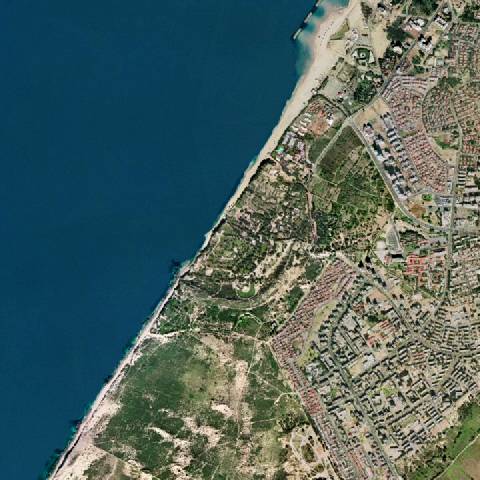 Ashkelon_Ascalon_TAs 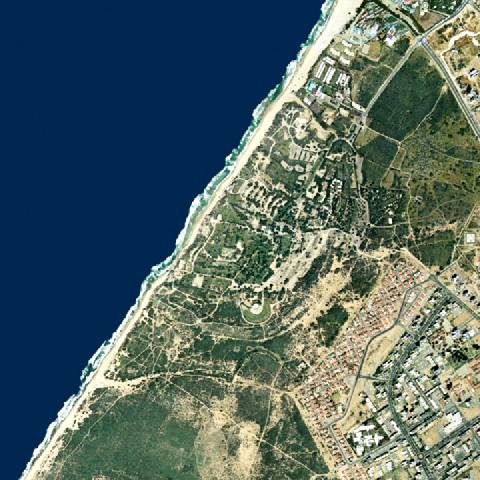 Ascalon 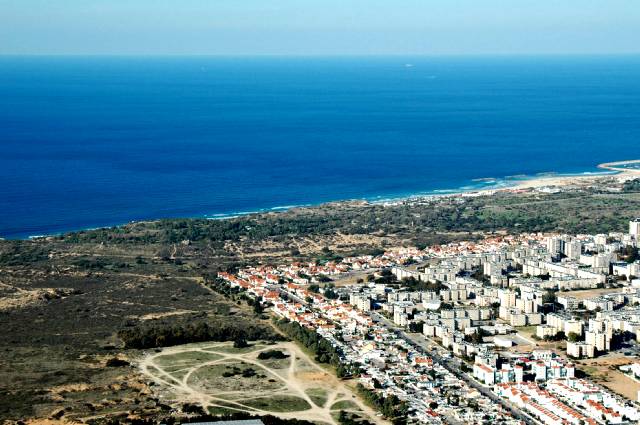 Ashkelon tell aerial from east, tb121704827 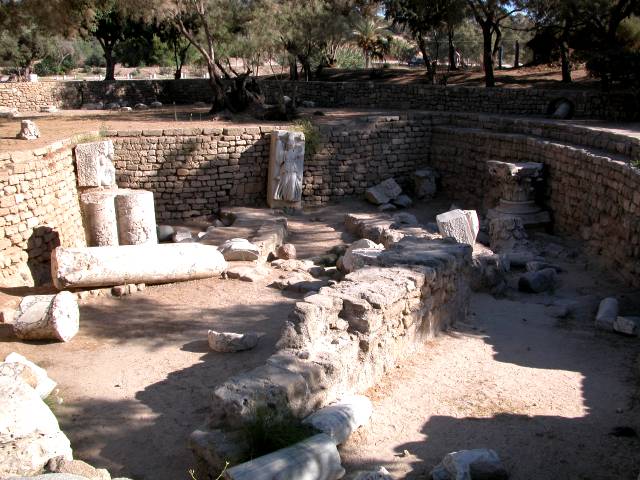 Ashkelon Roman ruins, tb 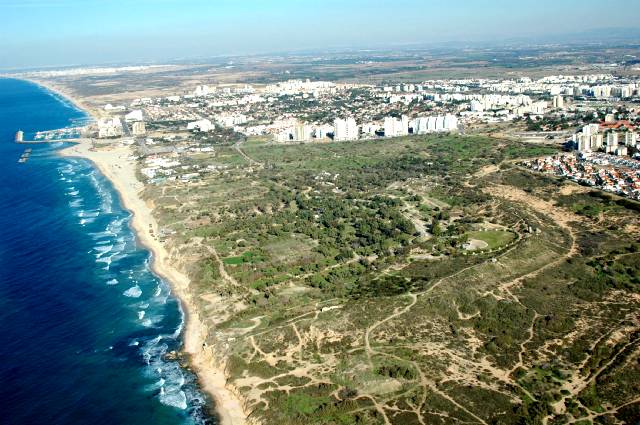 Ashkelon tell aerial from south, tb121704832 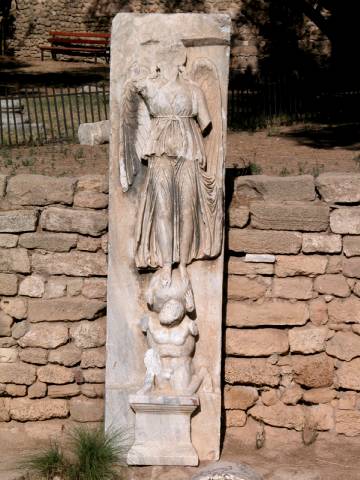 Ashkelon Roman statue, tb 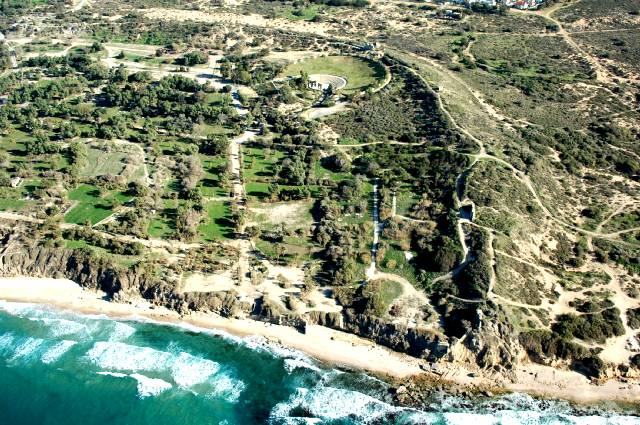 Ashkelon tell southern end aerial from west, tb121704834 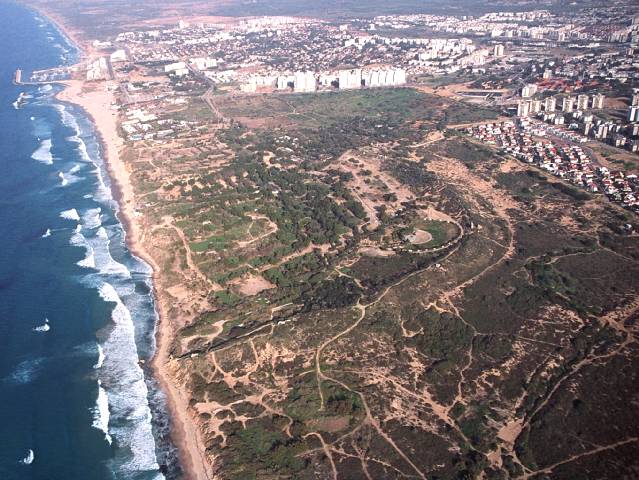 Ashkelon tell aerial from south, tb  Ashkelon aerial from southeast, tb121704822  Ashkelon Roman statue2, tb  Ashkelon tell aerial from northwest, tb121704841  Ashkelon tell aerial from west, tb121704837 |