
Places
KorinthosAlternative names: CorinthPlace descriptionCorinth is located immediately below Acrocorinth, which dominates the Isthmus and the land corridor between central Greece and Peloponnese. The ports at Kenchreai and Lechaion at both sides of the Isthmus served as the ports of the city. Due to the advantage of its geographical location and famous bronze production, Corinth played a significant role in trade and Greek colonization. Its earliest settlement can be traced back to the 10th century BC. Two tyrants Kypselos and Periander in the 7th and 6th century BC held the ruling power of the city and constructed massive walls around it. Between 338 and 243BC, the city was ruled by the Macedonians. In 146BC, it became a member of the Archaian League to fight against Rome. Corinth was consequently destroyed and its citizens were massacred by the Roman consul Mummius. Julius Caesar refounded the city in 44BC as a colony by settling ex-slaves from Rome. After the reestablishment of Corinth by Caesar, its trade grew steadily. A grid street plan was imposed on the city. A massive building program was also started in the 2nd century AD. From 27th BC onwards, Corinth became the administrative centre of the Roman governor in the province of Achaia until the 7th century AD. The Temple of Apollo, characterized by its peristyle of limestone columns, was built in 550BC on top of the site of an earlier temple which had the earliest known tile roof. Most of other remains in the city are dated to the Roman period. The pre-Roman agora should be at the north or northeast of the Temple of Apollo. But its centrality was diverted to the marbled paved Roman forum at the southeast of the temple. The forum was divided into two sections by the central shops which were probably used by the bankers of the city. In the middle of the shop line, there was a rostra or high speaker platform. In the northern and southern sides of the forum, stoas were installed on top of shops. The west side of the forum stood a square podium and a list of temples. The Babbius monument, dated to 1st century AD, was built inside the podium to house a statue. At the southeast section of the forum, there was a civic office. At the south of it, there was a Julian basilica. Decorated with marble veneer, this columnar hall housed the statues of Augustus and other imperial figures. The area in front of the basilica used to be the starting platforms of a Hellenistic race-course, which was buried beneath the Roman paving. The forum was connected to the cardo maximus (Lechaion Road) dated to the late first century AD. Not far from the entrance of the forum, a lintel stone has been found with lettering ‘Synagogue of the Hebrews’. This stone dates to the 4th century AD or even later. Its size suggests that it was actually been moved from its original location. The Fountain of Peirene was situated at the right of the cardo. North of this fountain, a late first century AD enclosure was decorated with a statue of Apollo and a painting of Odysseus slaying Penelope’s suitors. This enclosure also replaced an earlier Augustan fish market. The Temple E was dedicated either to Octavia or Jupita Capitolonus. It was rebuilt with Corinthian order after the earthquake in 77AD. North of The Temple E, there was an odeion and a theatre. The late 1st century AD odeion was rebuilt as an arena. An open courtyard linked it to the 4th century BC theatre, which was rebuilt by the colonists in the 1st century AD. It was subsequently converted into an arena for wildbeast shows in the early 3rd century AD and a water-basin for aquatic shows in the late first century AD. Images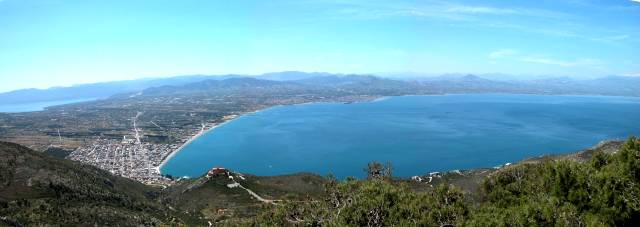 Corinth isthmus panorama, tb050803400 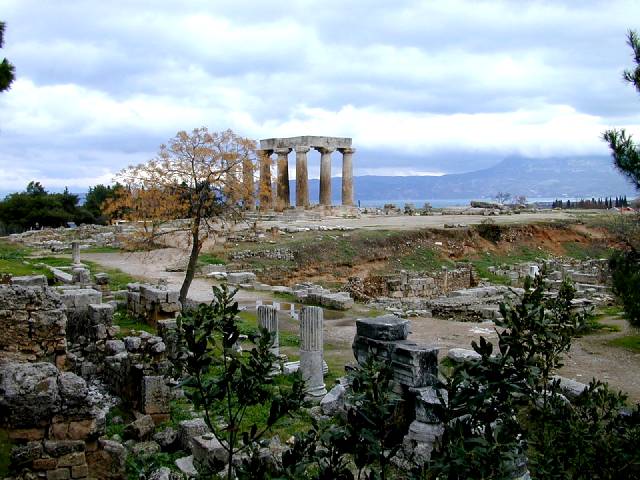 Corinth Temple of Apollo and excavations, tb 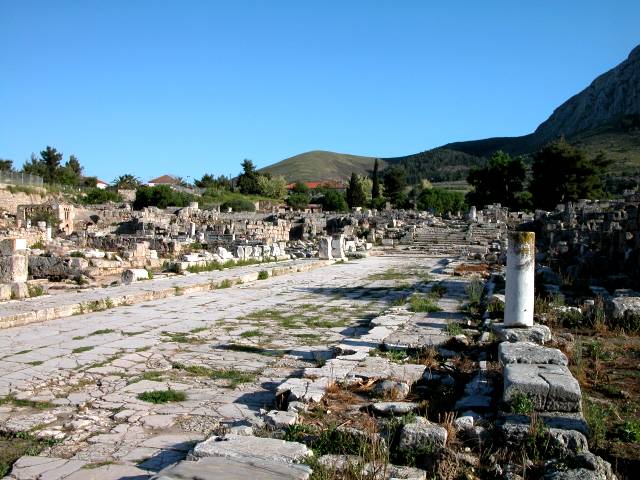 Corinth Lechaion Road from north, tb 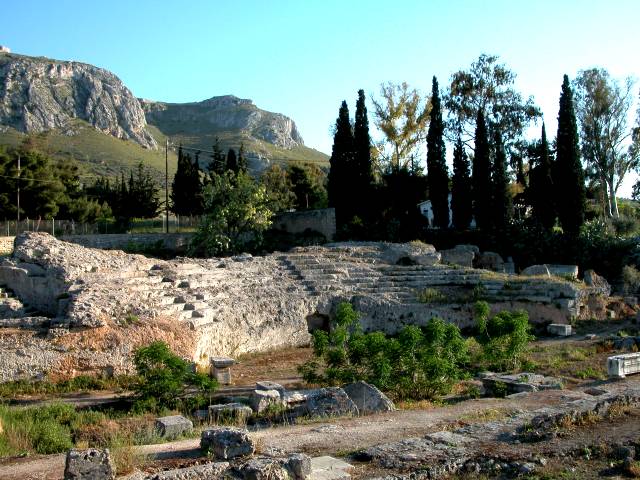 Corinth odeum, tb 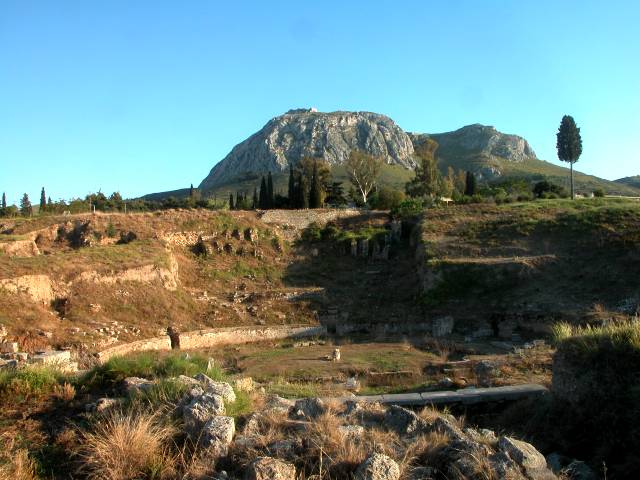 Corinth theater and Acrocorinth, tb 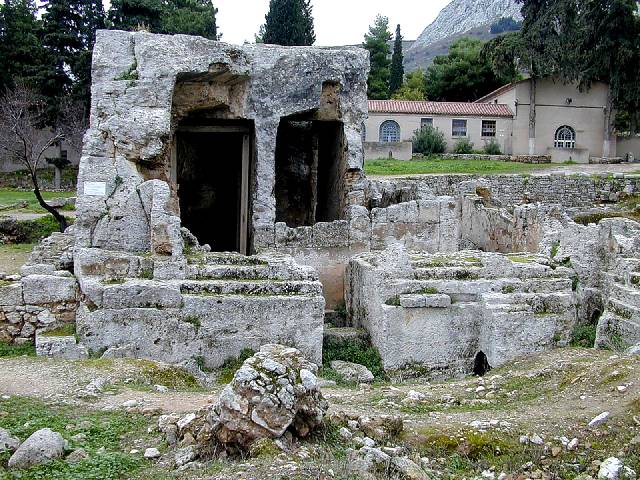 Corinth Glauke Fountain, tb 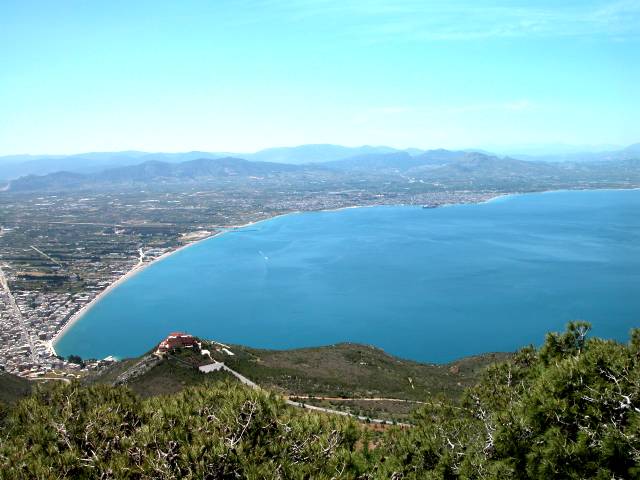 Corinth gulf from north, tb050803107 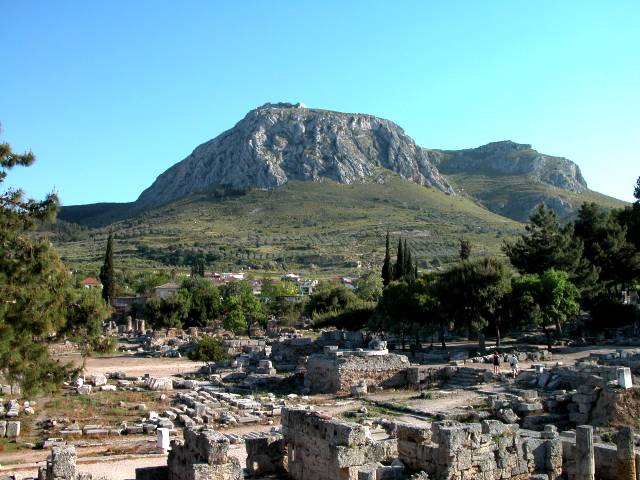 Corinth Acrocorinth excavations, tb 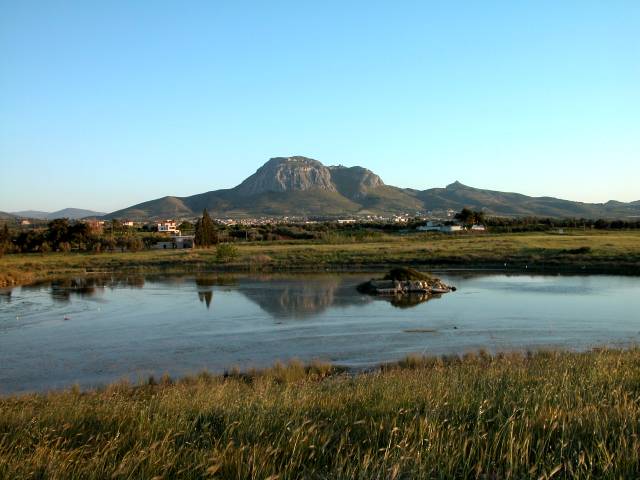 Corinth Lechaion harbor with Acrocorinth, tb 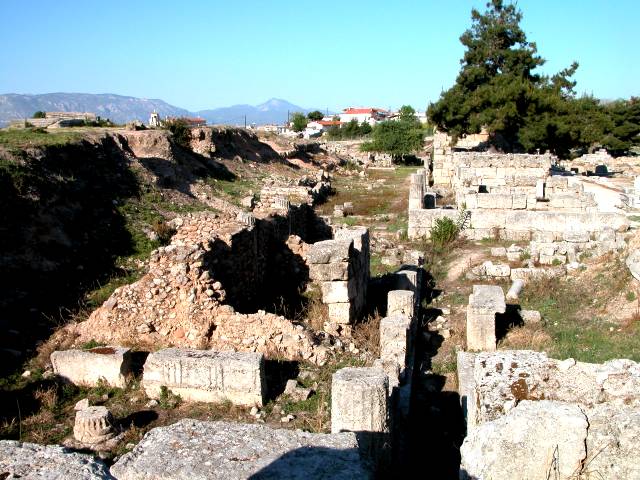 Corinth north stoa from west, tb 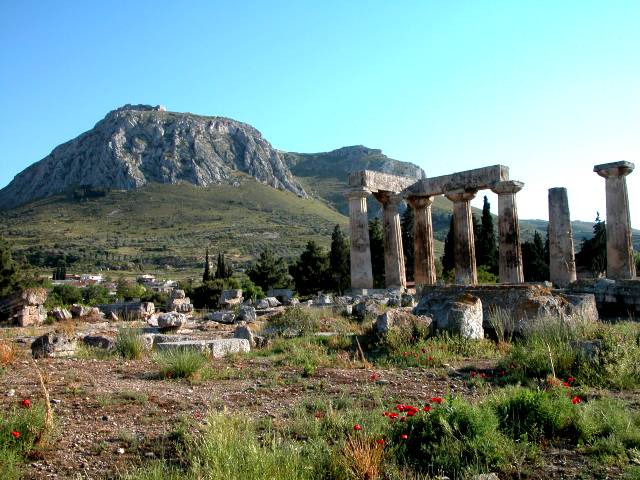 Corinth Temple of Apollo and Acrocorinth, tb 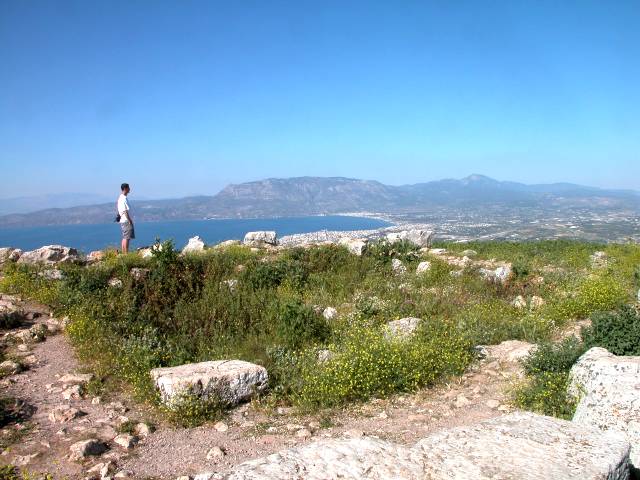 Corinth, Acrocorinth Temple Aphrodite, tb 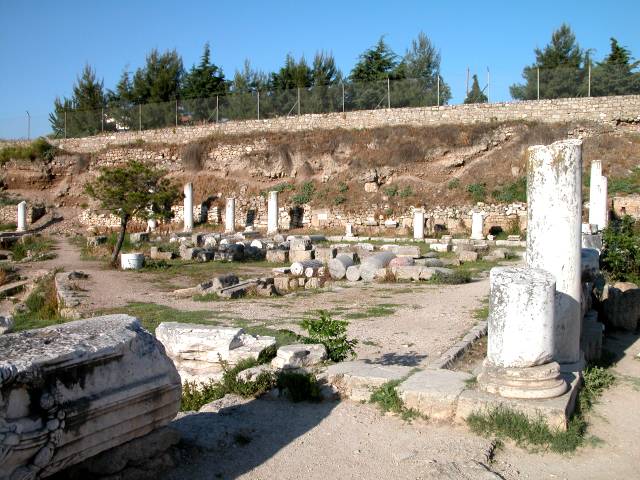 Corinth Peribolos of Apollo, tb 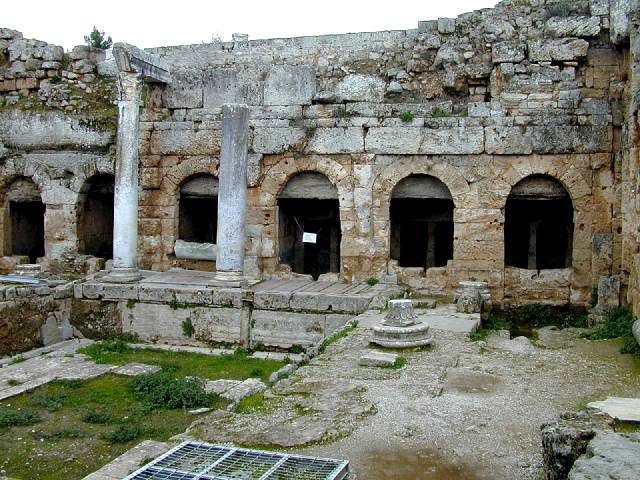 Corinth fountain of Peirene, tb 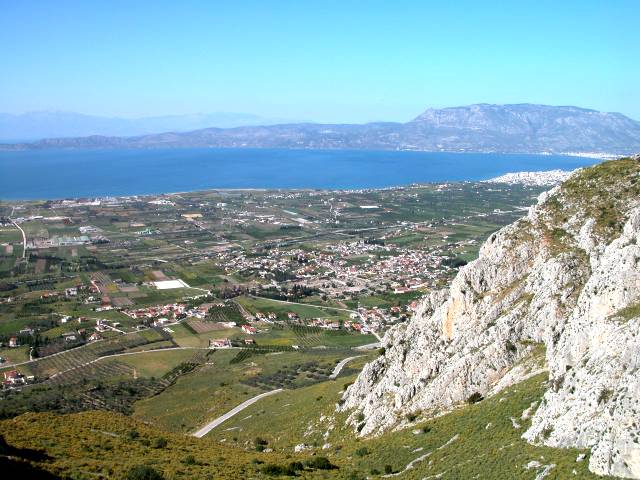 Corinth plain and excavations from Acrocorinth, tb050803135 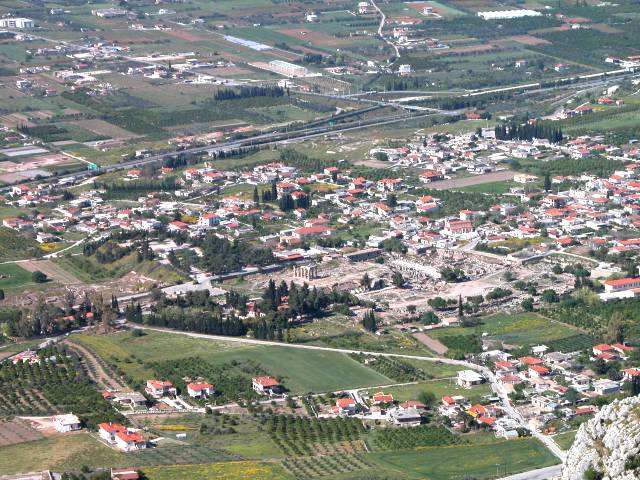 Corinth excavations from Acrocorinth, tb 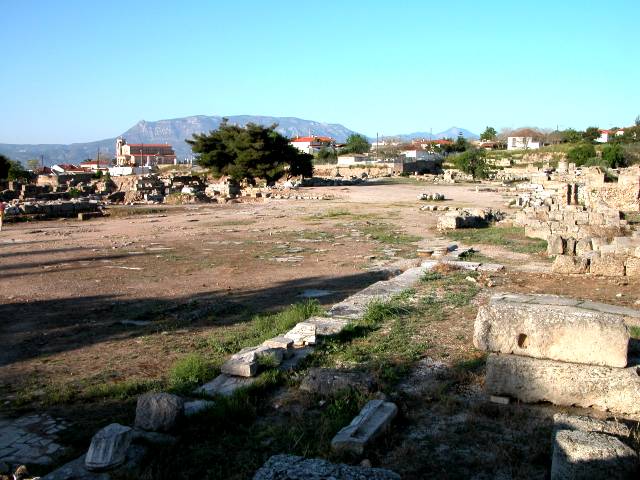 Corinth agora, tb Passages - PolybiusPolybius Commentary |